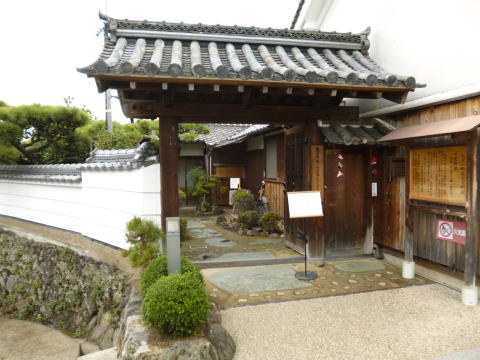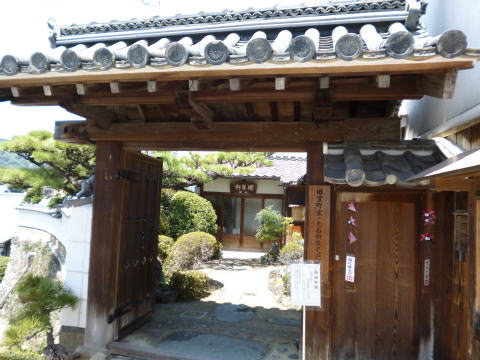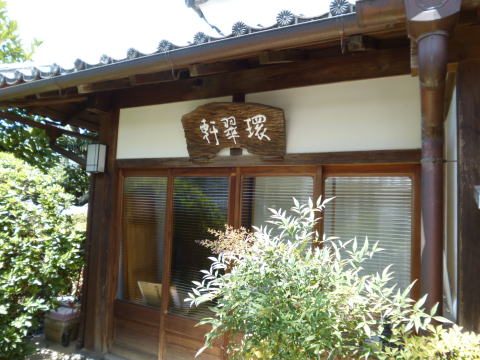

The Former Kayano Residence
The Former Kayano Residence is a structure designated by the town of Kudoyama,
Wakayama Prefecture.
Originally, the site was a temple of the Koyasan Kogi Shingon sect known as Fudō-in, established in 1703 (the 16th year of the Genroku era) by Yūson of Henjō-ji Temple.
During the tenure of the fourth head priest, Shinsei, the temple also served as Shinzō-in (a sub-temple of Mount Kōya); the head priest would descend from the mountain to stay there during the winter to escape the cold, effectively using the site as a *satobō* (a lowland residence for monks).
Three of its buildings—the main house, the gate, and the storehouse (*dozō*)—were
designated as Tangible Cultural Properties (Structures) by Kudoyama Town
on June 28, 1996, in recognition of their preservation of the architectural
style of a temple used as a winter retreat during the mid-Edo period.
In February 2009, ownership of the three Kayano family buildings was transferred to Kudoyama Town, and on December 25 of that year, the property was officially renamed the "Former Kayano Residence."
Nun Junkyō Ōishi (born Yone Ōishi; 1888–1968) was born in the Dōtonbori district of Osaka in 1888.
In 1905, at the age of 17, she fell victim to a frenzied attack by her adoptive father, Manjirō Nakagawa—an incident in which he slashed six people—and lost both of her arms.
While striving to overcome her tragic circumstances, she one day observed a canary feeding its chicks with its beak; this inspired the realization that she could use a brush with her mouth even without hands, and she subsequently devoted every spare moment to practicing calligraphy.
At the same time, she pursued rigorous training in the arts, mastering classical literature, *waka* poetry, and painting.
From around the age of 40, she dedicated herself to the Buddhist path and to promoting independence education for people with physical disabilities, while also focusing her efforts on welfare counseling. Later, through an acquaintance of Masanosuke Kayano—the head of the Kayano family—she deepened her ties with the family. In 1933, with the Kayano couple (Masanosuke and Tatsu) serving as her sponsors, she entered the priesthood at Tentoku-in Temple on Mount Koya under the guidance of High Priest Tentoku Kanayama, receiving the religious name "Junkyo."
She maintained a close relationship with the Kayano family, frequently staying at their home, and works of calligraphy and painting created during those visits are currently on display.
She was active in various fields, notably becoming the first member from East Asia of the Association of Mouth and Foot Painting Artists of the World in 1962. She passed away at the age of 80 in 1968 at Kasho-an in Yamashina, Kyoto.
To honor the remarkable achievements of Nun Junkyo Oishi, Kudoyama Town has—since 2010—operated the former Kayano residence as the Nun Junkyo Oishi Memorial Hall, where her calligraphy and other artifacts are preserved and exhibited.
The "Arm Mound" (Udezuka) and the grave of Nun Junkyo Oishi are located at the Okunoin area of Mount Koya.
A 7-minute walk from Kudoyama Station on the Nankai Koya Line.