Namba Yasaka Shrine

Namba Yasaka Shrine
Namba Yasaka Shrine is located in Naniwa Ward, Osaka City.
The enshrined deities are
Susanoo-no-Mikoto, Kushinadahime-no-Mikoto, and Yahashira-no-Miko-no-Mikoto.
While the exact date of its founding is
unknown, by the Enkyū era (1069–1074) of Emperor Go-Sanjō's reign, it was
revered under the name Gozu Tennō-sha as a guardian deity offering protection
against misfortune, bringing good fortune, and watching over agriculture and
river transport.
In the past, the shrine was known as
"Shimo-no-Miya" (Lower Shrine)—in contrast to
"Hira-no-Myōjin" (Namba Shrine in Chūō Ward), which was called
"Kami-no-Miya" (Upper Shrine)—and it is said that *mikoshi* (portable
shrine) processions took place between them.
According to the *Settsu Meisho Zue*
(Illustrated Guide to Famous Sites in Settsu Province), the shrine complex
included a facility known as "Daimonbō" where the deity Jinja Daiō
(Jinja-daio)—an incarnation of Tamonten (Vaiśravaṇa)—was worshipped; the site was originally a Buddhist temple complex
featuring the traditional seven-building layout (*shichidō garan*), and rituals
were conducted by shrine monks.
A ritual tug-of-war takes place in front of
the *torii* gate on January 14 and 15 (the third Sunday of January).
This tradition is said to commemorate the
legend of the shrine's deity, Susanoo-no-Mikoto, slaying the Yamata-no-Orochi
serpent and relieving the people of their suffering; the event was designated
an Intangible Folk Cultural Property in 2001.
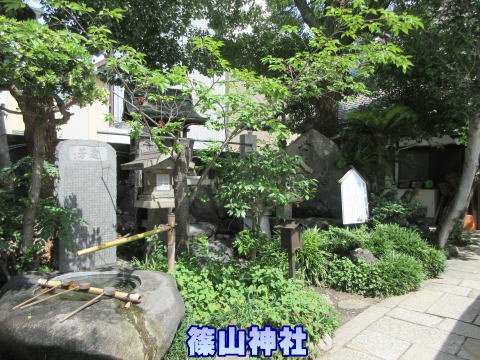
A subsidiary shrine, Sasayama Shrine, is
located within the precincts.
Built in 1880, it enshrines Sasayama Jūbei,
an Osaka magistrate (*daikan*) credited with establishing vegetable markets in
the villages of Namba and Kizu.
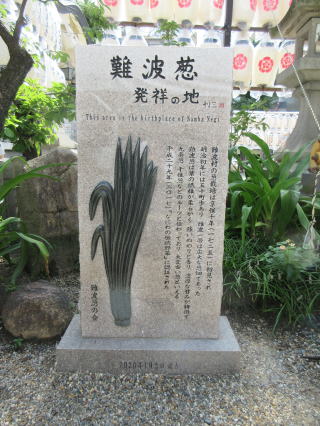
In 2020, a stone monument marking the
"Birthplace of Namba Negi (Namba Green Onion)" was erected at the
site.
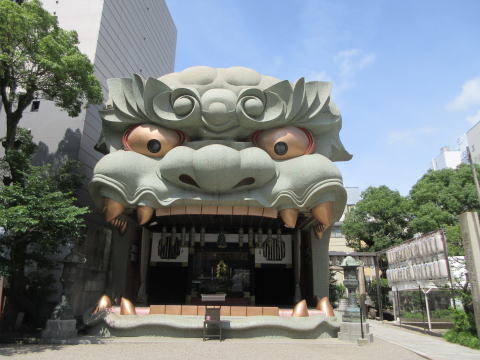
The Shishi-den (Lion Hall)
Standing 12 meters tall with a depth and
width of 7 meters, this hall was completed in May 1974, coinciding with the
completion of the Main Hall.
The structure is built of steel and
reinforced concrete, with some interior sections made of wood; the exterior
features a synthetic resin finish sprayed with copper powder. Inside the
sanctuary, the *aramitama* (wild spirit) of the enshrined deity, Susanoo-no-Mikoto,
is venerated; a pair of Kaga-style lion figures rests upon a *karabitsu*
(traditional lidded chest). The lions feature brass teeth and eye rims. The
phoenix carvings set into the coffered ceiling are all hand-carved, each with a
unique design. Additionally, the lions' eyes serve as lights, while their noses
function as speakers.
Various performing arts are dedicated on
the stage, including *Kagura* (sacred music and dance) and *Iaido* (martial art
of drawing the sword) during the New Year, and the Lion Dance and folk dances
during the summer festival. The enshrined deity, Susanoo-no-Mikoto, is also
revered as the god who composed Japan's first *waka* poem.
At the end of 2008, the interior and front
facade were renovated through a donation from a local benefactor, restoring the
structure to its original, radiant splendor.
TOP PAGE 観光カレンダー
TOP PAGE 观光最佳时期